Total Quality Management (TQM)
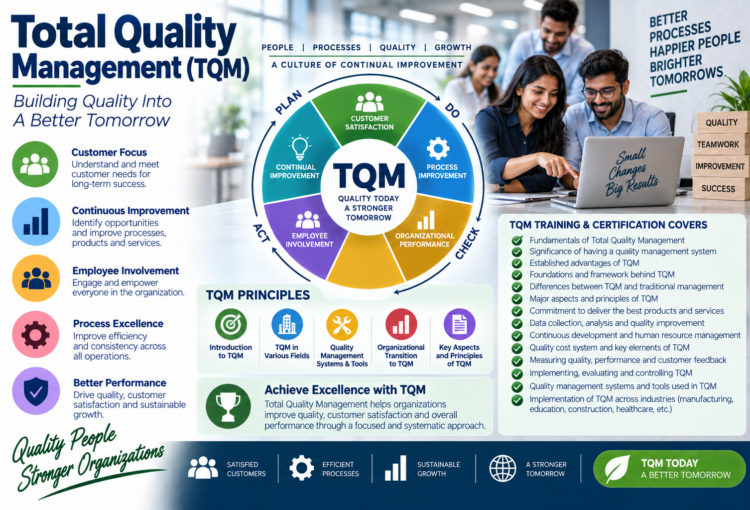 Total Quality Management (TQM) is a customer-focused approach that involves everyone in an organization in the continual improvement of processes, products, and services. TQM aims to improve organizational performance by focusing on quality, customer satisfaction, employee involvement, process improvement, and consistent business practices. TQM applies across the entire organization and focuses on improving processes, products, services, and organizational performance. It emphasizes customer satisfaction, employee involvement, process improvement, and a culture of continual improvement across different areas of the organization.
TQM training and certification programs can help professionals understand the concepts, principles, tools, and techniques used in Total Quality Management. Topics may include quality management systems, TQM implementation, process improvement, organizational transition, performance measurement, customer feedback, and continual improvement. Organizations can also strengthen their formal quality management systems through ISO 9001 Certification.
Total Quality Management Principles
- Introduction to Total Quality Management
- TQM in Various Fields
- Quality Management Systems and Tools
- Paving the Way for Organizational Transition to TQM
- Important Aspects and Principles of TQM
Total Quality Management can help organizations improve quality, customer satisfaction, and overall performance. A TQM program may cover the fundamentals and principles of quality management, quality management systems and tools, process improvement, performance measurement, customer feedback, employee involvement, and the implementation of TQM across different industries. Included in the coverage of our total quality management certification course are the following:
- Fundamentals of total quality management
- Significance of having a quality management system
- Established advantages of TQM
- Foundations and framework behind total quality management
- Differences between the practices used in TQM and the practices used in traditional management
- Understanding all the major aspects and principles behind total quality management
- Committing to give the best products and services to clients
- Gathering data and analyzing them to start improving the quality of products and services
- Continuous development and human resources management and their relationship to TQM
- Vital elements of the total quality management system and quality cost system
- Building a framework that will efficiently measure quality
- Measuring and analyzing both performance and feedback
- Implementing, evaluating and controlling TQM
- Understanding the different systems and tools used in TQM and their individual functions and benefits
- Implementing total quality management in a variety of industries and fields including the manufacturing industry, education, construction and healthcare