

Halal Certification
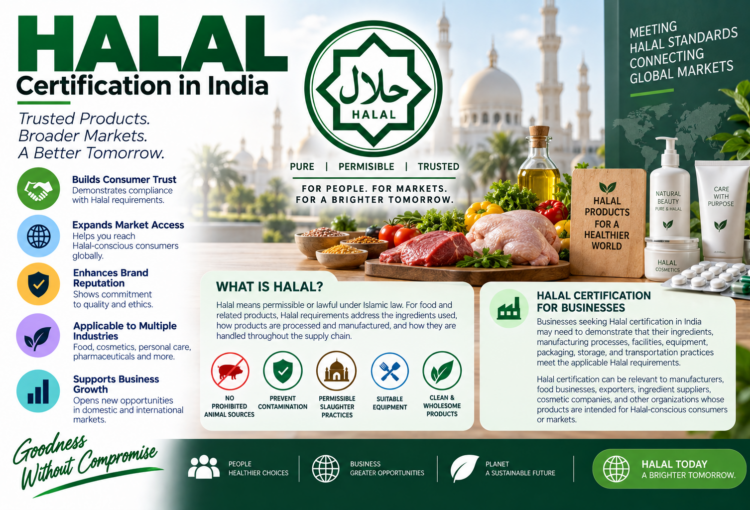 Halal certification in India helps businesses demonstrate that their products, ingredients, and processes meet applicable Halal requirements. Halal refers to products and practices that are permissible under Islamic law. Halal certification can apply to food, ingredients, cosmetics, personal care products, pharmaceuticals, and food-contact materials.
The Halal certification process may cover sourcing, processing, manufacturing, packaging, storage, handling, and transportation. Obtaining Halal certification can help businesses demonstrate that their products follow relevant Halal requirements and are suitable for Halal-conscious consumers and markets.
What Is Halal?
Halal means permissible or lawful under Islamic law. For food and related products, Halal requirements can address the ingredients used, how products are processed and manufactured, and how they are handled throughout the supply chain.
For food products, Halal requirements generally include the following:
- Permissible ingredients: Products must not contain any part or item from animals forbidden under Islamic law, such as pork or other prohibited animal sources.
- Prevention of contamination: During preparation, processing, manufacturing, packaging, storage, and transportation, Halal products must be protected from contact with prohibited substances or impurities.
- Permissible animal slaughter: Where animal products are involved, animals must be permissible under Islamic law and slaughtered according to applicable Halal requirements.
- Suitable equipment: Food must be processed or manufactured using tools, equipment, and utensils that meet applicable Halal requirements and are free from prohibited contamination.
- Clean and permissible products: Food products should be wholesome and free from substances considered impure or prohibited under Islamic law.
Halal Certification for Businesses
Businesses seeking Halal certification in India may need to demonstrate that their ingredients, manufacturing processes, facilities, equipment, packaging, storage, and transportation practices meet the applicable Halal requirements.
Halal certification can be relevant to manufacturers, food businesses, exporters, ingredient suppliers, cosmetic companies, and other organizations whose products are intended for Halal-conscious consumers or markets.
Businesses looking to strengthen their food safety practices can also explore HACCP Certification.